
Here is something I (Stuart) wrote about the greatest Argentine heavy metal band, V8, whose first LP I picked up in Buenos Aires during our visit. This piece was originally published on Bidhardcore, a site dedicated to quick reviews of records that are on auction at the moment on eBay. It's directed toward the record-collector audience of that site.
V8 was the first true heavy metal band from Argentina and arguably the first from South America. Like the classic Argentine punk band Los Violadores, V8’s first LP was released by the independent label Umbral in 1983. “Luchando Por El Metal” is a landmark record, and it’s a shame it is not more well-known outside Argentina. It’s such a classic in Argentina that one can hardly walk down the street without encountering headbangers pledging allegiance to V8 (pronounced VAY-OH-CHO).
The online heavy metal archive site Encyclopaedia Metallum is full of effusive praise for V8, as is the South American metal history site Metaleros, which includes a great history of the band and Argentine metal in general. To really understand where the band was coming from, you need to know about Argentine guitar god Pappo, whom I’ll get to in a minute, but this riff-driven LP really just sounds like a mixture of Motörhead and Judas Priest, with a dash of Black Sabbath. It’s not NWOBHM, it’s FWOAHM. Some of the faster (and better) songs even have a feeling akin to metal-influenced UK hardcore of the early 80s, unfortunately minus Discharge’s drumbeat. Think GBH. (Fans of Canada’s Inepsy would probably love this record.) The production is perfect for this type of music, without any fancy embellishment: guitars prominent, bass drum and vocals next in line.
“Luchando Por El Metal” is not particularly rare because thousands were pressed, but it had zero distribution outside Latin America when it was released as far as I know. Also, Argentines do not have much of a collecting culture, meaning “mint” in Argentina is quite different from “mint” here in the land of Puritanism, and the flimsy stock used for the jacket doesn’t lend itself to durability. In addition, one listen to this LP will demonstrate why it tends to be in “partied-on” condition. It’s a ripper.
Like Los Violadores’ first LP, “Luchando Por El Metal” includes a printed inner sleeve with lyrics. And what lyrics they are! True headbanging fanatics will derive great pleasure, if not goosebumps, from songs like “Brigadas Metálicas,” “Tiempos Metálicos” (lyrics: “Basta de hippies / basta de rogar / estalló el tiempo del metal”), and “Hiena de Metal”—yes, Hyena of Metal! About that last one, which closes the album, V8 collaborated with their hero Pappo on this one (he plays the solo), which I found surprising because it’s the shortest and fastest tune on the record. It actually reminds me of Chelsea’s guest solo on that one Selfish song, if that helps: the whole band concept was inspired by this virtuoso and when he collaborated with them on a song, he threw a curve ball, unlike anything he’d done before. Anyway, the lyrics, as far as my rudimentary grasp of Spanish tells me, combine the dumb dark “poetry” typical to metal since Sabbath with cheeky irreverence, as in the song about a visit to a torturador known as the dentist! (In a country where people were actually being tortured and killed by the military dictatorship, such a joke probably came across as tasteless to both sides.)
To digress on Pappo (né Norberto Napolitano), who died in a motorcycle crash in 2005, this guy was without peer. He was a hero to millions, especially those who saw him as a working-class rocknroll outsider type, the perpetual underdog. He released over a dozen LPs and even more singles throughout his career, which began in the late 1960s. His group Pappo’s Blues, which released seven albums in the 1970s, was a pioneering hard-rock/psych/heavy blues-rock act. In 1977, he formed Aeroblus, another heavy blues-rock band. And in 1980, influenced by AC/DC, he formed Riff, which is the band of greatest interest to me. (I haven’t heard all of what he released, but Riff seems better than either of the previous bands.) Veering more toward heavy metal, away from blues rock, Riff is a band quite worthy of its name. Fans of riff-centric rocknroll would do well to check them out (obviously). I saw a few copies of their records in Buenos Aires; the first, “Ruedas de Metal,” is pretty cool. Don’t pay much more than US $20 for it because thousands of copies were pressed. Psych collectors seem to think that Pappo’s Blues Vol. 3 is the most desirable of his 70s albums, but it doesn’t move me much. Vol. 7 from 1978 was recommended to me as much heavier than Vol. 3, but this one seems to have some sort of “Southern” rock influence, with a bunch of slide guitar. It’s got some cool, slow riffs, but overall it’s not really heavy or ballsy in comparison to what was happening in the UK or Australia at the time. Headline: “Southern rock meets the southern cone: Scumbags rejoice, ride motorcycles, drink maté.” Oh yeah, most Pappo’s Blues songs are instrumentals. You’ve been warned.
Anyway, if you’re not ready to delve too far into Argentine 70s–80s rock, the only records you need from this site’s perspective are V8’s and Los Violadores’ first LPs. “Luchando Por El Metal” is on eBay relatively frequently for buy-it-now prices around $80. That’s too much, in my opinion. But I say you ignore this record at your own peril. One listen and you too will become a hiena de metal.
Wednesday, March 18, 2009


Tuesday, June 24, 2008
Wacky Bs As
Lest you all think that we've been sitting at home footnoting research papers and having post-structural debates about memorialization this whole vacation, we wanted to share some of the hilarity we've come upon in the last couple of weeks:
So, it's winter here. We have the (meager) heat on whenever we're home. Which is an OPEN FLAME. Luckily, there has been no dog-singeing thus far:
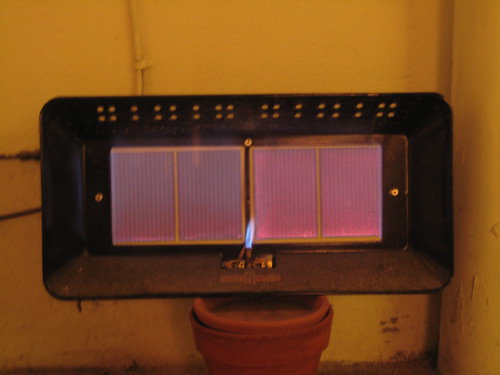
Yes, there is a window open at all times, so we don't die of carbon monoxide poisoning. Yes, this defeats the purpose of having the heat on. Welcome to Argentina.
Um, and we're a long way from Mexico. That soup below?
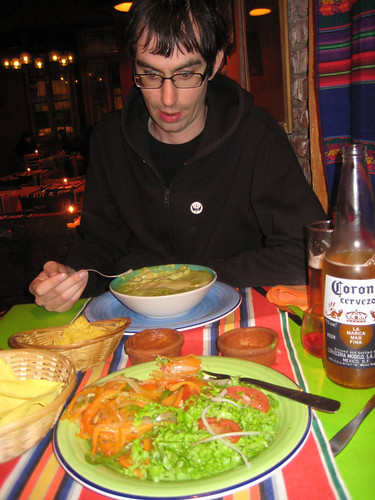
Bowl-o-enchiladas. They were good, though.
And I can't imagine what a spectacle it created when they drove this Argentina-themed tank to its spot on display:
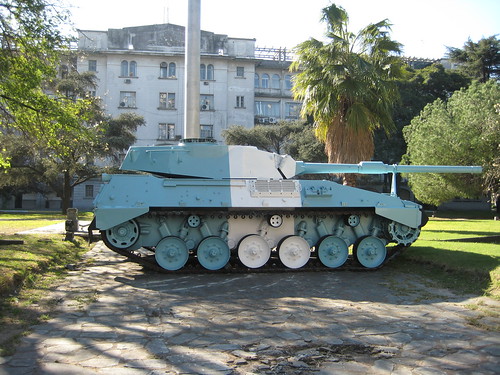
Especially given that you can still see the tank tracks in the pavement. I wonder if the bus tried to cut him off when he slowed to turn into the military base.
One animal we overlooked in our zoo post was this giant freaking turtle:
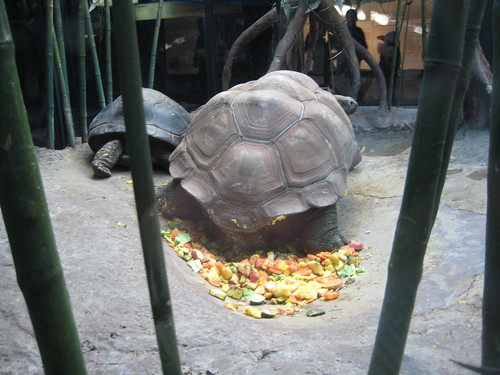
Who had clearly eaten some of this food, but then just backed in and sat-the-fuck-down. Maybe out of spite for the other giant freaking turtle? But he sure as hell wasn't moving.
Oh, right, and we haven't spent EVERY waking moment in the house researching rare Argentine records. Sometimes, we play ping-pong:
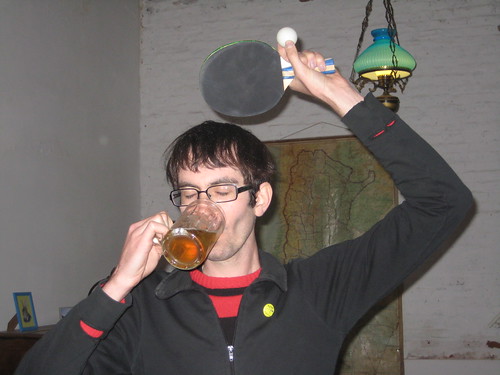
Um, and drink beer.
Oh! And we haven't been snapping photos only of anti-capitalist graffiti. Sometimes, there is such heartfelt sentiment written on a bridge, you can't help yourself.
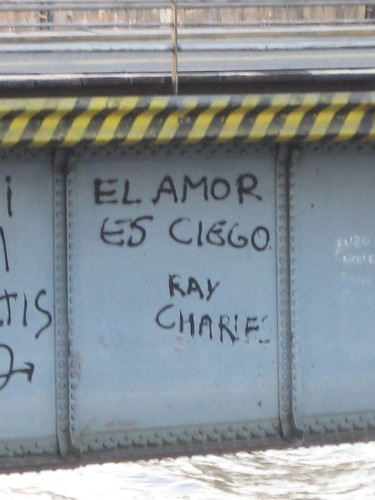
Yes, it says, "Love is blind. -Ray Charles."
Then, just when we're starting to get homesick, we run into this, in Belgrano:
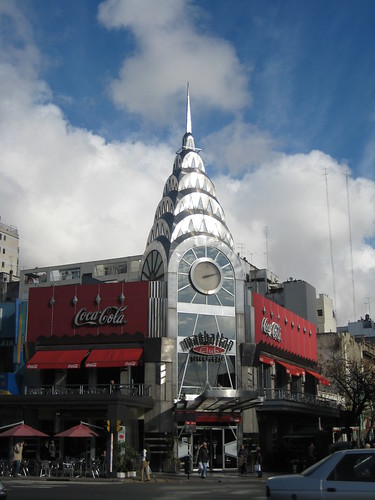
Why go back to New York, when you can get a burger and a coke in the Chrysler Building right here?
Sadly, though, the sun glinting off the Chrysler-replica caused pain for more than just us Neoyorquinos:
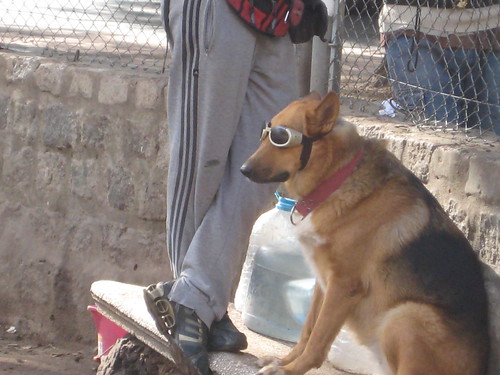
Even the dogs in Belgrano gotta shield their eyes from that shit. He do look cool, though.
And then we stumbled across Buenos Aires' only religious-themed amusement attraction: Tierra Santa. Sadly, it was closed. But we enjoyed ourselves at the Lord's expense nonetheless:
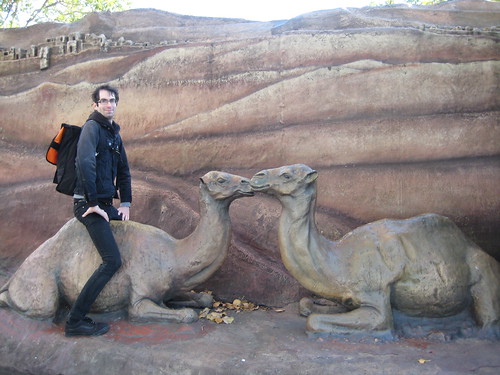
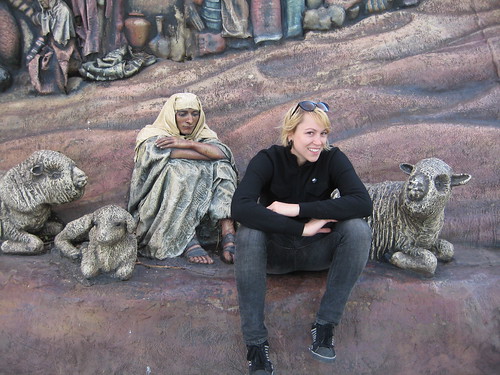
Dude all the way to the left looked a little suspect. Personally, I don't know if there were any elephant seals in Bethlehem or whatever, but he looked chill, so we hung out for awhile.
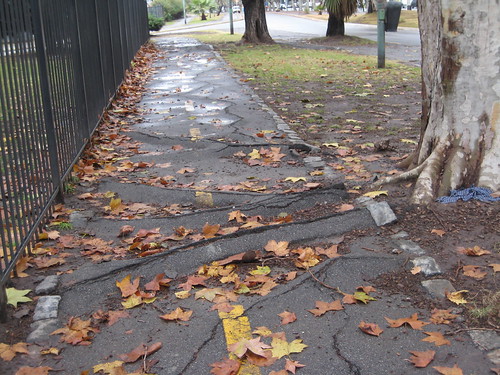
Everyone from our hosts to the guidebooks told us that biking in this town would be absurdly difficult. But it's not, if you're willing to ignore that fact that no one drives in a lane, red lights mean nothing, and the way to get through an intersection is to get there first and play chicken with the oncoming traffic until someone either 1) passes or 2) crashes. (Before we started riding bikes everywhere, we were very nearly killed in taxis on multiple occasions.) Oh, and also, the few bike paths that exist look like this:
But there are plenty of bikers out and about in Buenos Aires. Like this guy, who clearly needs these aero-wheels for his grocery run:

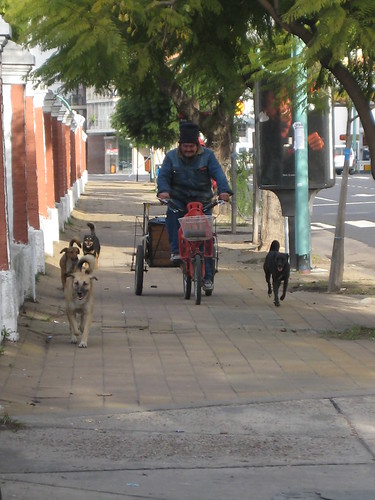
Or this guy, whose entourage of dogs could fend off any taxi:
And then, after a long ride through the bustling city, dodging buses and breathing in diesel fumes, Argentines and their best friends can look forward to a delicious frozen meal:

So, it's winter here. We have the (meager) heat on whenever we're home. Which is an OPEN FLAME. Luckily, there has been no dog-singeing thus far:
Yes, there is a window open at all times, so we don't die of carbon monoxide poisoning. Yes, this defeats the purpose of having the heat on. Welcome to Argentina.
Um, and we're a long way from Mexico. That soup below?
Bowl-o-enchiladas. They were good, though.
And I can't imagine what a spectacle it created when they drove this Argentina-themed tank to its spot on display:
Especially given that you can still see the tank tracks in the pavement. I wonder if the bus tried to cut him off when he slowed to turn into the military base.
One animal we overlooked in our zoo post was this giant freaking turtle:
Who had clearly eaten some of this food, but then just backed in and sat-the-fuck-down. Maybe out of spite for the other giant freaking turtle? But he sure as hell wasn't moving.
Oh, right, and we haven't spent EVERY waking moment in the house researching rare Argentine records. Sometimes, we play ping-pong:
Um, and drink beer.
Oh! And we haven't been snapping photos only of anti-capitalist graffiti. Sometimes, there is such heartfelt sentiment written on a bridge, you can't help yourself.
Yes, it says, "Love is blind. -Ray Charles."
Then, just when we're starting to get homesick, we run into this, in Belgrano:
Why go back to New York, when you can get a burger and a coke in the Chrysler Building right here?
Sadly, though, the sun glinting off the Chrysler-replica caused pain for more than just us Neoyorquinos:
Even the dogs in Belgrano gotta shield their eyes from that shit. He do look cool, though.
And then we stumbled across Buenos Aires' only religious-themed amusement attraction: Tierra Santa. Sadly, it was closed. But we enjoyed ourselves at the Lord's expense nonetheless:
Dude all the way to the left looked a little suspect. Personally, I don't know if there were any elephant seals in Bethlehem or whatever, but he looked chill, so we hung out for awhile.
Everyone from our hosts to the guidebooks told us that biking in this town would be absurdly difficult. But it's not, if you're willing to ignore that fact that no one drives in a lane, red lights mean nothing, and the way to get through an intersection is to get there first and play chicken with the oncoming traffic until someone either 1) passes or 2) crashes. (Before we started riding bikes everywhere, we were very nearly killed in taxis on multiple occasions.) Oh, and also, the few bike paths that exist look like this:
But there are plenty of bikers out and about in Buenos Aires. Like this guy, who clearly needs these aero-wheels for his grocery run:
Or this guy, whose entourage of dogs could fend off any taxi:
And then, after a long ride through the bustling city, dodging buses and breathing in diesel fumes, Argentines and their best friends can look forward to a delicious frozen meal:
Monday, June 23, 2008
Turismo anti-imperialista?
We enjoyed a long and lovely dinner of empanadas and Argentine wine with former Naclista Eduardo Joly the other night. In addition to Eduardo, the guests included other members of REDI, the Red por los Derechos de las Personas con Discapacidad (Network for the rights of the disabled): Eduardo, who uses a wheelchair; his wife, Silvia, an architect who has written the book on urban spaces and disability in Argentina; Marilu and Facundo, two lawyers who also use wheelchairs; Carolina, a blind psychologist; and Pamela, a deaf Chilean student at the University of Chicago. We were so privileged to be able to participate in (to the small degree that we did) a fascinating discussion with them regarding disability in Argentina, and in Latin America more generally, as well as about identity and disability...as someone put it that night, not about who is in and who is out, but about "quienes somos"—as a group, fighting together for rights, who the disabled are.
Over the course of many bottles of wine, a massive heap of empanadas, and a sampling of fernet con coca, the locals were all curious to know how we'd been passing our time in Argentina. We told them we'd been to the MALBA, the Museo de Bellas Artes, and other tourist spots. But when we said that we'd been to a few off-the-beaten-path places, like Parque Rivadavia, they joked that only turistas anti-imperalistas would go to such places. And yeah, maybe that does describe what we've been doing the last few days:
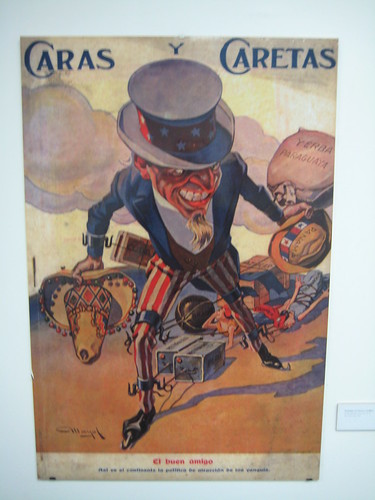
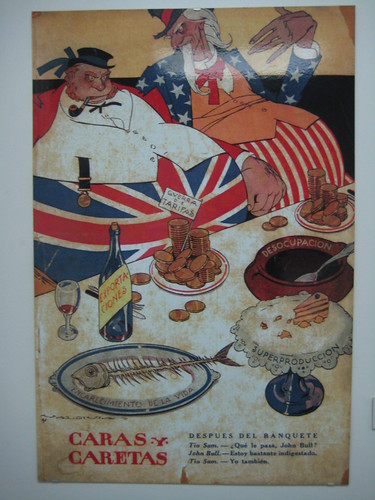
First stop was the Museo de Deuda Externa: a museum dedicated exclusively to the history of Argentina's foreign debt.
Where else can you find art about the Brady Plan?

Or demonstration art about the poverty line?
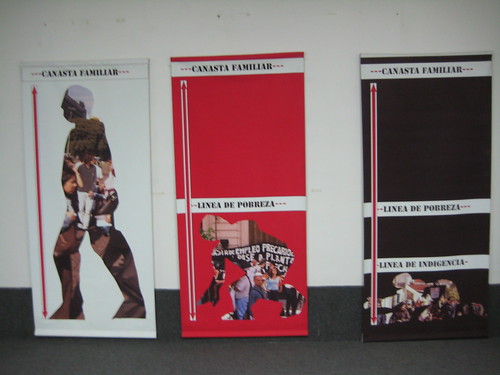
Other exhibits included an "anniversary album" celebrating 50 years since Argentina "wed" itself to the IMF; a series of sculptures about unemployment levels using tiny dolls of San Cayetano, the patron saint of work; and a cascade of the many currencies that Argentina has used over the past few decades. One can only hope that, in the coming years, there will be more anti-IMF museums in the world.
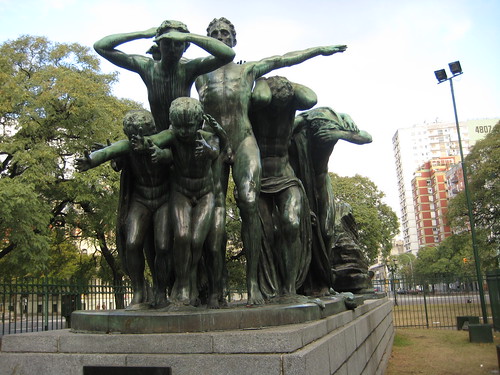
So then we tried to be normal tourists and headed down to San Telmo on Sunday, along with every other foreigner in the country. But soon we strayed down to the sculpture "Canto al Trabajo" by Rogelio Yrurtia:
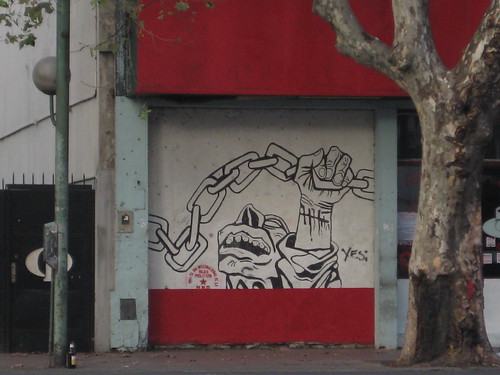
And then down the Paseo de Colon, past Asambleas street art:
To the Memory Recovery Project of the Secret Detention Facility "El Atlético," an archeological memorial site under a highway overpass.
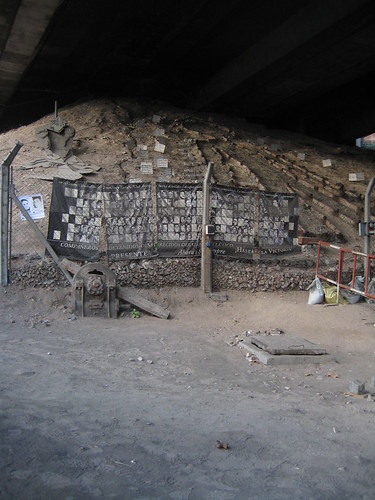
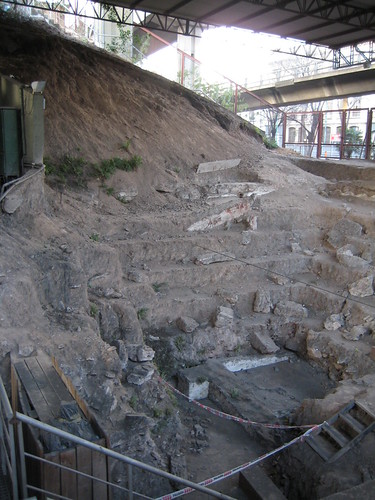
During most of 1977, some 1,800 people were kidnapped and brought here, to a secret torture facility in the basement of an athletic club. Only about 300 survived to tell about it, and, in 1978, the dictatorship demolished the building to make way for the highway, literally burying the secret and the bodies of 1,500 desaparecidos. Only in 2002, after much agitation by human rights activists, was the site unearthed and this memorial created. Later, a more official memorial park was created across the street, but it was closed and locked when we were there. And while the excavation site was very moving, as we stood in the grime, under this overpass, on a huge avenue with little foot traffic, we couldn't help but feel as though this space of memory, indeed, this memory itself, had been forgotten...or at least kept in the dark.
Then it was back up into the San Telmo street market, where we ran into the booths of the Asambleas movement and agoratv.org, where a guy selling radical DVDs knew of NACLA and invited us to visit Hotel BAUEN, a cooperatively run, recuperated hotel.
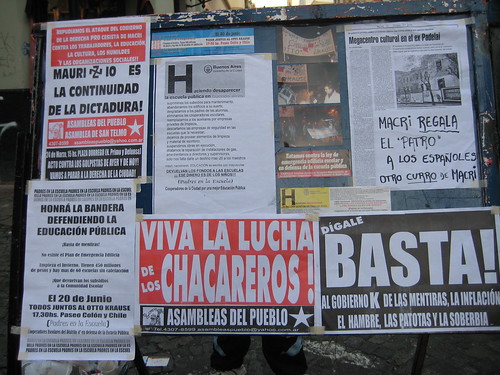
Then today, after a quick jaunt through Chinatown in Belgrano...

(sadly, no coypus de soja to be found)
...we rode up toward the city line to the Escuela de Mecanica de la Armada (ESMA).
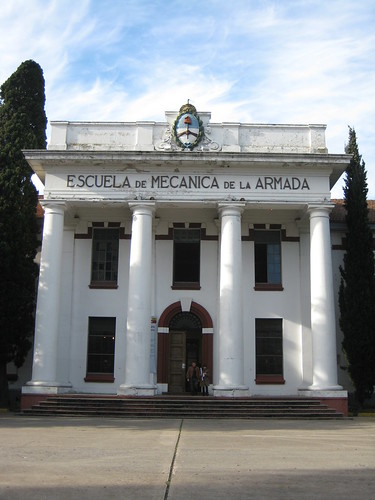
ESMA, a Navy training facility, was the largest detention center during the dirty war, where some 5,000 people were disappeared, with only 200 survivors. In 2004, it became a memorial museum, the Espacio para la Memoria y para la Promoción y Defensa de los Derechos Humanos.

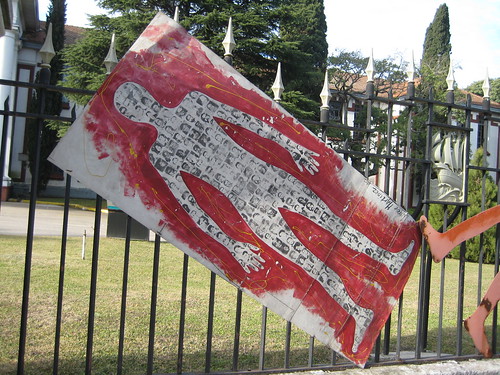
To visit the grounds, we would have had to make an appointment for a guided tour (which we hadn't done), so then we rode out to the river, again, to find the Parque de la Memoria.
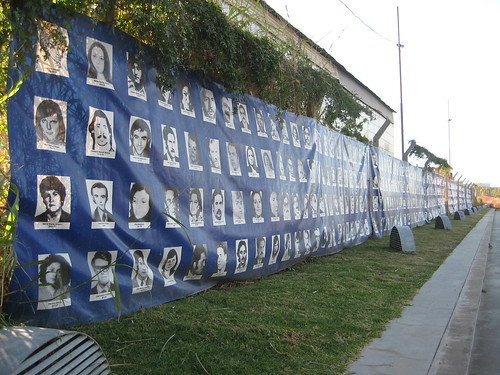
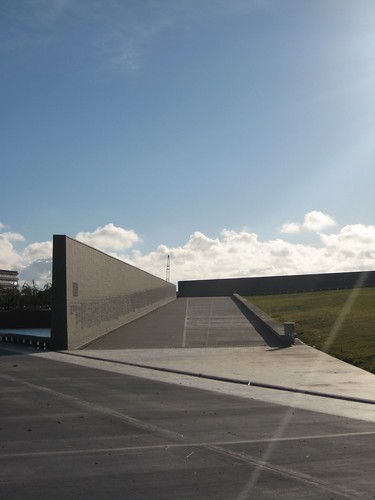
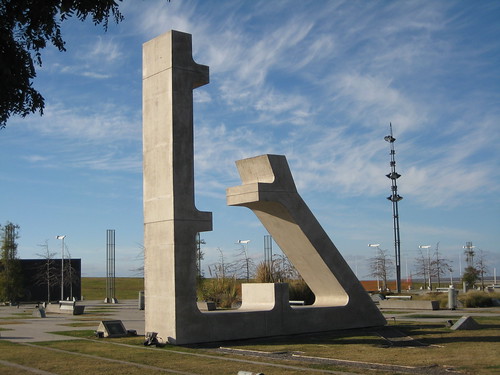
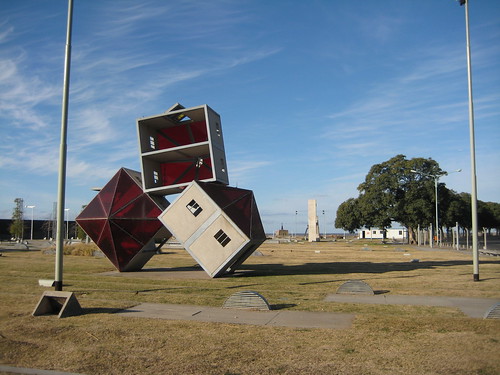
This memorial, the Monument to Victims of State Terror, was inaugurated in late 2007 but is still not open to the public, as much of the park is still under construction (the friendly dreadlocked hippy in the information booth told us it was scheduled to open in August.) The atmosphere was ruined somewhat by the loud and very insistent cat-calls we were getting from the construction workers (Stuart's legs really drive 'em wild), but the site itself is very striking, perched at the northern end of the path along the river's edge.
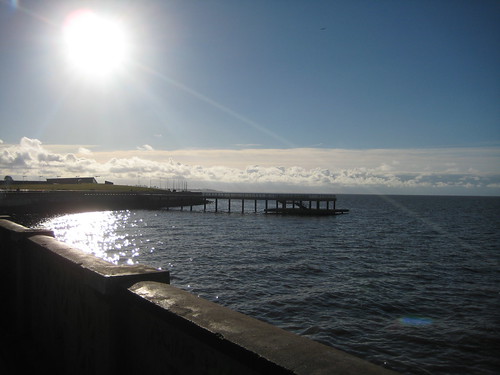
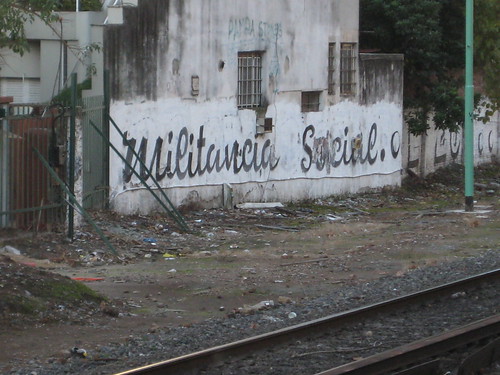
So we rode back home, across the railroad tracks, our brains full of questions about cities, and memory, and activism, and memorialization—reminders of which, in this city, are everywhere....
Over the course of many bottles of wine, a massive heap of empanadas, and a sampling of fernet con coca, the locals were all curious to know how we'd been passing our time in Argentina. We told them we'd been to the MALBA, the Museo de Bellas Artes, and other tourist spots. But when we said that we'd been to a few off-the-beaten-path places, like Parque Rivadavia, they joked that only turistas anti-imperalistas would go to such places. And yeah, maybe that does describe what we've been doing the last few days:
First stop was the Museo de Deuda Externa: a museum dedicated exclusively to the history of Argentina's foreign debt.
 |  |
Where else can you find art about the Brady Plan?
Or demonstration art about the poverty line?
Other exhibits included an "anniversary album" celebrating 50 years since Argentina "wed" itself to the IMF; a series of sculptures about unemployment levels using tiny dolls of San Cayetano, the patron saint of work; and a cascade of the many currencies that Argentina has used over the past few decades. One can only hope that, in the coming years, there will be more anti-IMF museums in the world.
So then we tried to be normal tourists and headed down to San Telmo on Sunday, along with every other foreigner in the country. But soon we strayed down to the sculpture "Canto al Trabajo" by Rogelio Yrurtia:
And then down the Paseo de Colon, past Asambleas street art:
To the Memory Recovery Project of the Secret Detention Facility "El Atlético," an archeological memorial site under a highway overpass.
During most of 1977, some 1,800 people were kidnapped and brought here, to a secret torture facility in the basement of an athletic club. Only about 300 survived to tell about it, and, in 1978, the dictatorship demolished the building to make way for the highway, literally burying the secret and the bodies of 1,500 desaparecidos. Only in 2002, after much agitation by human rights activists, was the site unearthed and this memorial created. Later, a more official memorial park was created across the street, but it was closed and locked when we were there. And while the excavation site was very moving, as we stood in the grime, under this overpass, on a huge avenue with little foot traffic, we couldn't help but feel as though this space of memory, indeed, this memory itself, had been forgotten...or at least kept in the dark.
Then it was back up into the San Telmo street market, where we ran into the booths of the Asambleas movement and agoratv.org, where a guy selling radical DVDs knew of NACLA and invited us to visit Hotel BAUEN, a cooperatively run, recuperated hotel.
Then today, after a quick jaunt through Chinatown in Belgrano...
(sadly, no coypus de soja to be found)
...we rode up toward the city line to the Escuela de Mecanica de la Armada (ESMA).
ESMA, a Navy training facility, was the largest detention center during the dirty war, where some 5,000 people were disappeared, with only 200 survivors. In 2004, it became a memorial museum, the Espacio para la Memoria y para la Promoción y Defensa de los Derechos Humanos.
To visit the grounds, we would have had to make an appointment for a guided tour (which we hadn't done), so then we rode out to the river, again, to find the Parque de la Memoria.
 |  |
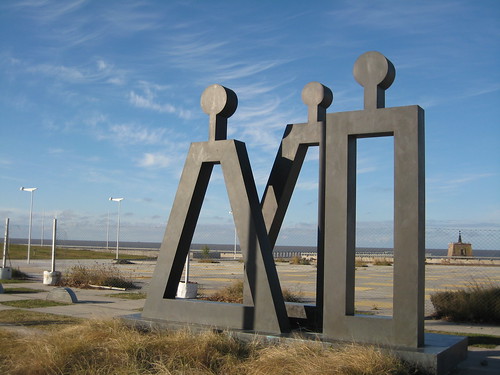 | 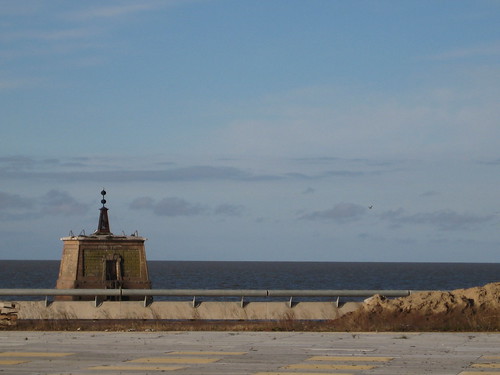 |
This memorial, the Monument to Victims of State Terror, was inaugurated in late 2007 but is still not open to the public, as much of the park is still under construction (the friendly dreadlocked hippy in the information booth told us it was scheduled to open in August.) The atmosphere was ruined somewhat by the loud and very insistent cat-calls we were getting from the construction workers (Stuart's legs really drive 'em wild), but the site itself is very striking, perched at the northern end of the path along the river's edge.
So we rode back home, across the railroad tracks, our brains full of questions about cities, and memory, and activism, and memorialization—reminders of which, in this city, are everywhere....
Saturday, June 21, 2008
Unevenness of Development: Yacht Clubs and Dinosaurs
Our travels across this city have revealed the unevenness of its development and, most interestingly, the forgotten, obsolescent, and recrementitious spaces that are left behind as cities embrace "progress." Often, these are the interstitial spaces, the edges of industrial zones or government tenancies, the often trash-strewn spots that are surely owned by someone on paper but of which no one takes ownership. In these spaces, street art often springs up, as cavalier creative types highlight the contradictions of such property that no one cares about until someone else decides to care about it (one can't help but think too, here in Argentina, of the Malvinas/Falklands in these terms).
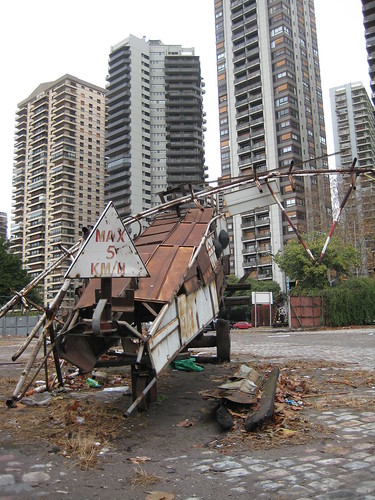
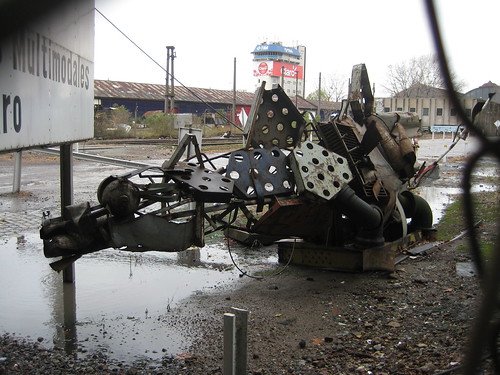
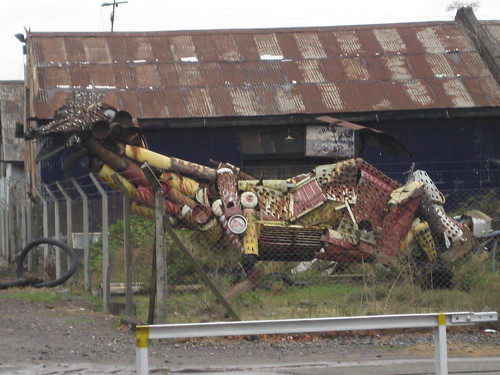
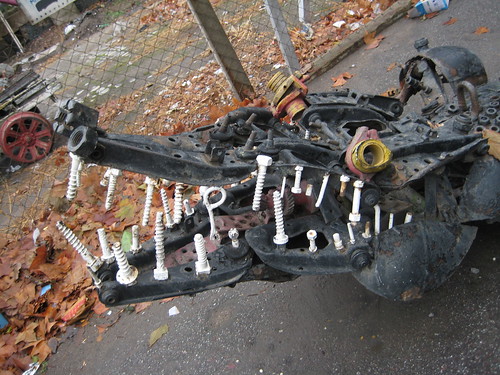
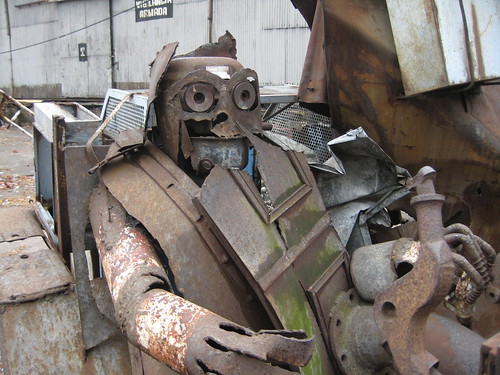
At the edge of an enormous railyard, bounded to the north by the Retiro slum and to the south by high-rise apartments and hotels, we stumbled across a sculpture workshop/theater/arts space called El Gato Viejo. It is full of sculptures cobbled together from industrial detritus, mostly in the shape of old cars, airplanes, and dinosaurs—essentially obsolete and decrepit pieces of iron, tin, and aluminum put together to whimsically represent obsolete or extinct forms that have perennially captured our imagination. El Gato Viejo is anything but neat and orderly, and because our visit occurred during a rainstorm, the mud and puddles were fierce. Although the city has given this alternative arts space permission, it does not come across as a clean, inviting arts exhibit meant for tourists. It's dirty and grimy, lacking in pretense—it's beside railyards, composed of industrial waste, and it doesn't pretend otherwise.
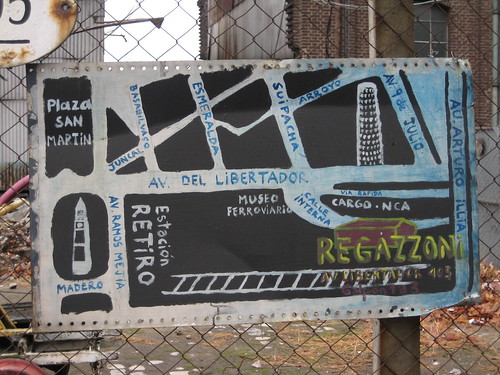
In other areas, grassroots memorials spring up, such as one near the back of the Once train station devoted to the 200 or so jovenes who died in a fire at the Cromañon rock club in 2004, attempting to escape through doors bolted and wired shut by club owners trying to keep fans from sneaking in without paying.
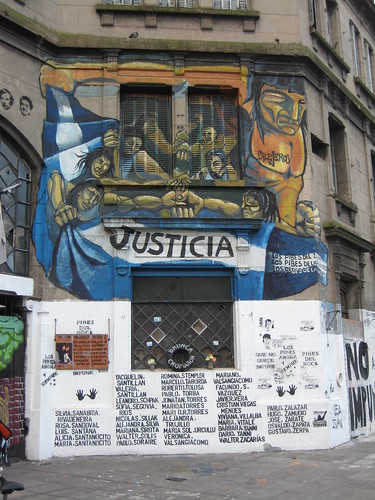
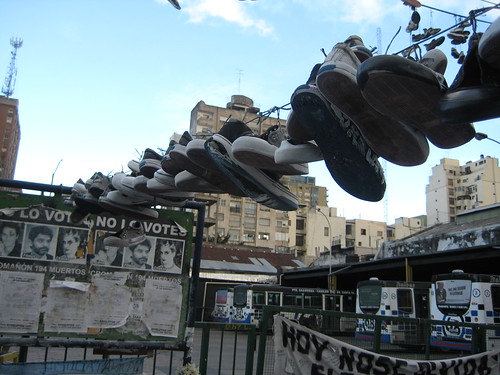
Anyway, this cityscape is fascinating because, unlike New York, Buenos Aires has not (yet) engaged in a wholesale erasure of the past as de rigueur urban planning policy. Though there was certainly slum clearance in decades past (particularly as the highways that traverse the city were built), today gentrification is its more "genteel" heir, displacing working-class residents and neighborhood businesses—plumbers, glass-makers, welders, auto-repair shops, upholsterers, all of those trades that rely on the conservation and repair of old things, rather than their replacement. In Palermo Hollywood, for example, high-rise condos, boutiques, and restaurants catering to foreigners and the "creative class" (manifested here by those working for the many television and movie studios) are rapidly squeezing out what was here before, in this neighborhood of working people once known as Pacifico.
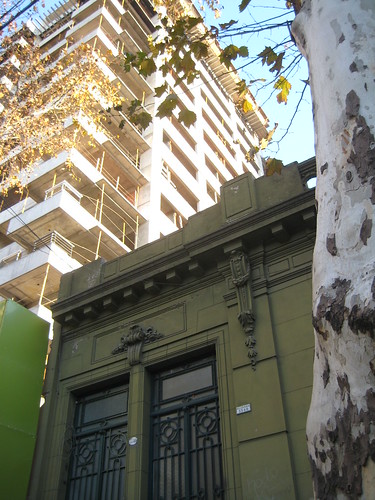
In the neoliberal period, beginning more or less with President Menem, Argentina has embraced models of urban development now seen throughout the world. Inevitably, some spaces have been left behind, and these are the ones that often offer the best insight into the dreams of the past, or the repressed memories of the present, as seen above. Elsewhere in the city, the unevenness of development is not quite as visible by direct juxtaposition; instead, the lack of older, traditional housing and businesses points to a wholly forward-looking neighborhood identity. Puerto Madero, which was a fallow port space made obsolescent by container shipping, has become a sort of touristic themepark (themes: "global city," "redevelopment"), with its requisite Santiago Calatrava bridge next to its requisite Hooters.

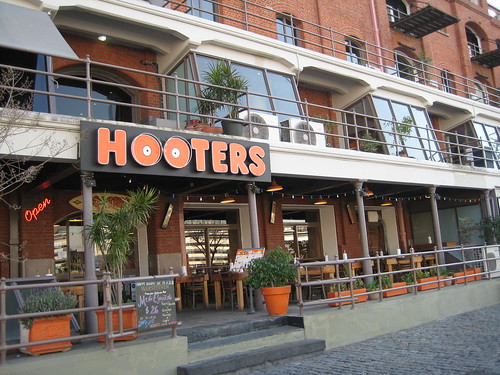
As cool as the Calatrava bridge may be, its function is the same as Calatrava bridges worldwide: to symbolize the arrival of neoliberalism. No urban redevelopment, in the post-Guggenheim-Bilbao age, is complete without a signature architectural spectacle, and, in a hundred years, historians will look back and see so many of Calatrava's (and Gehry's) works as period pieces. In this case, the bridge is actually fairly tasteful. That the bridge is functional (ie, movable) is a paean to the memory of Puerto Madero as the center of Buenos Aires' port. Today, Calatrava's bridge rarely needs to open; its function is its aesthetics, its spectacle-commodity-ness. If the city were concerned with using the most up-to-date technology for its movable harbor bridges, the Calatrava wouldn't be a superfluous pedestrian bridge south of the harbor's mouth and the yacht club. (One assumes a pedestrian bridge designed by Calatrava is cheaper than an auto bridge.)
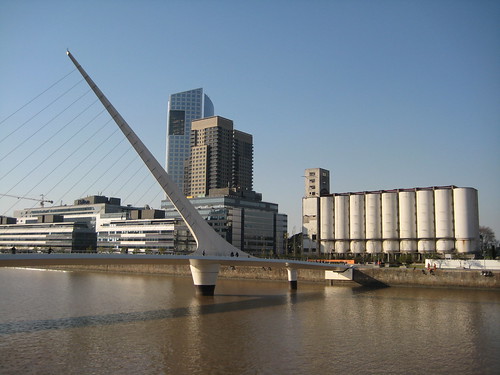
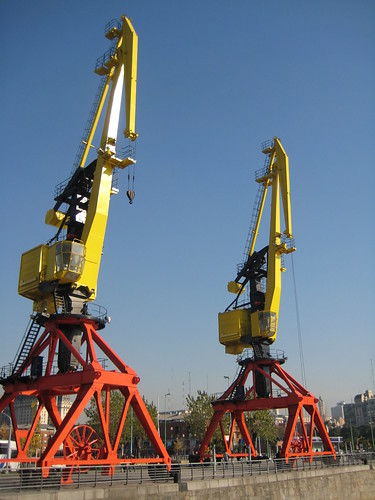
Puerto Madero combines reclaimed grain storage facilities—now turned into lofts and restaurants—as well as a newly constructed museum (not open yet) and many new office and upscale residential buildings, with, ostensibly, the only functional use of these waters: a yacht club. Unlike New York City, which has all but completely turned its back on its past as a major port, Buenos Aires was never the ideal locale for a shipping center due to its geography (and hydrography, I suppose)—and even still, it maintains a large, modern container port just to the north of this tourist destination. Despite the economic rollercoaster of the last 50+ years here, Buenos Aires has managed to maintain what is central, in my opinion, to a healthy working class in a postindustrial era: its port. In this way, the use of old dock cranes as decorations around Puerto Madero doesn't come off as crass or tasteless.
But the idea of starting fresh, in a completely new part of the city, away from the hustle and bustle—and away from the social problems of the older neighborhoods (like poverty!)—is creepy and a bit fascistic. It's clear, however, that activists in this city won't let such an attempt to turn away from reality go unnoticed: in 2006, piquetero leader Raúl Castells opened a small lunch counter here to feed poor youth and elderly people, which was later shuttered by government order.
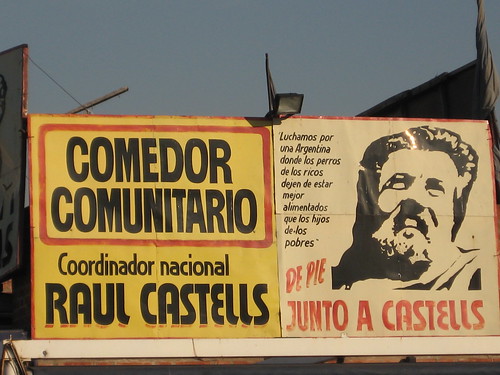
One imagines that the slogan "We fight for an Argentina where the dogs of the rich do not eat better than the children of the poor," however apposite, didn't sit well with those buying the exclusive condos across the water.
Since its "redevelopment," Puerto Madero has become a haven for speculators. After the economic crisis of 2001, real estate, especially in the form of speculation, has been the growth industry for two reasons: first, well-heeled Argentines no longer trust the banks as they once did, and real estate offers what seems like a sounder investment; second, overseas clients can purchase real estate of a caliber that might be out of reach at home due to the favorable exchange rate. Thus, Puerto Madero, which was basically a no-go zone at the end of the dictatorship, with disused warehouses and grain silos, is now the place for foreigners to buy up property. The number of high rises under construction or recently completed there is astounding. And, so, the repurposing of this area mirrors the overall retooling of the global economy under regimes of deindustrialization, financialization, and rampant speculation.
With all that in mind, who needs a pizza and a beer?
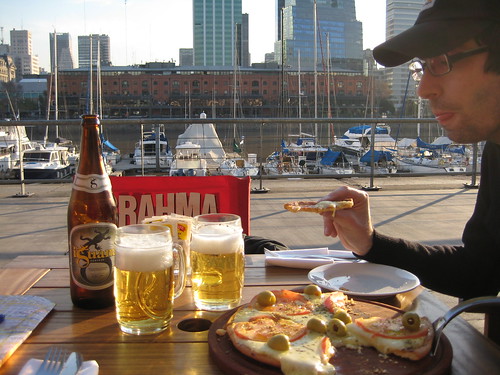
You don't want to know what we paid for it.
At the edge of an enormous railyard, bounded to the north by the Retiro slum and to the south by high-rise apartments and hotels, we stumbled across a sculpture workshop/theater/arts space called El Gato Viejo. It is full of sculptures cobbled together from industrial detritus, mostly in the shape of old cars, airplanes, and dinosaurs—essentially obsolete and decrepit pieces of iron, tin, and aluminum put together to whimsically represent obsolete or extinct forms that have perennially captured our imagination. El Gato Viejo is anything but neat and orderly, and because our visit occurred during a rainstorm, the mud and puddles were fierce. Although the city has given this alternative arts space permission, it does not come across as a clean, inviting arts exhibit meant for tourists. It's dirty and grimy, lacking in pretense—it's beside railyards, composed of industrial waste, and it doesn't pretend otherwise.
 |  |
 |  |
In other areas, grassroots memorials spring up, such as one near the back of the Once train station devoted to the 200 or so jovenes who died in a fire at the Cromañon rock club in 2004, attempting to escape through doors bolted and wired shut by club owners trying to keep fans from sneaking in without paying.
Anyway, this cityscape is fascinating because, unlike New York, Buenos Aires has not (yet) engaged in a wholesale erasure of the past as de rigueur urban planning policy. Though there was certainly slum clearance in decades past (particularly as the highways that traverse the city were built), today gentrification is its more "genteel" heir, displacing working-class residents and neighborhood businesses—plumbers, glass-makers, welders, auto-repair shops, upholsterers, all of those trades that rely on the conservation and repair of old things, rather than their replacement. In Palermo Hollywood, for example, high-rise condos, boutiques, and restaurants catering to foreigners and the "creative class" (manifested here by those working for the many television and movie studios) are rapidly squeezing out what was here before, in this neighborhood of working people once known as Pacifico.
In the neoliberal period, beginning more or less with President Menem, Argentina has embraced models of urban development now seen throughout the world. Inevitably, some spaces have been left behind, and these are the ones that often offer the best insight into the dreams of the past, or the repressed memories of the present, as seen above. Elsewhere in the city, the unevenness of development is not quite as visible by direct juxtaposition; instead, the lack of older, traditional housing and businesses points to a wholly forward-looking neighborhood identity. Puerto Madero, which was a fallow port space made obsolescent by container shipping, has become a sort of touristic themepark (themes: "global city," "redevelopment"), with its requisite Santiago Calatrava bridge next to its requisite Hooters.
As cool as the Calatrava bridge may be, its function is the same as Calatrava bridges worldwide: to symbolize the arrival of neoliberalism. No urban redevelopment, in the post-Guggenheim-Bilbao age, is complete without a signature architectural spectacle, and, in a hundred years, historians will look back and see so many of Calatrava's (and Gehry's) works as period pieces. In this case, the bridge is actually fairly tasteful. That the bridge is functional (ie, movable) is a paean to the memory of Puerto Madero as the center of Buenos Aires' port. Today, Calatrava's bridge rarely needs to open; its function is its aesthetics, its spectacle-commodity-ness. If the city were concerned with using the most up-to-date technology for its movable harbor bridges, the Calatrava wouldn't be a superfluous pedestrian bridge south of the harbor's mouth and the yacht club. (One assumes a pedestrian bridge designed by Calatrava is cheaper than an auto bridge.)
Puerto Madero combines reclaimed grain storage facilities—now turned into lofts and restaurants—as well as a newly constructed museum (not open yet) and many new office and upscale residential buildings, with, ostensibly, the only functional use of these waters: a yacht club. Unlike New York City, which has all but completely turned its back on its past as a major port, Buenos Aires was never the ideal locale for a shipping center due to its geography (and hydrography, I suppose)—and even still, it maintains a large, modern container port just to the north of this tourist destination. Despite the economic rollercoaster of the last 50+ years here, Buenos Aires has managed to maintain what is central, in my opinion, to a healthy working class in a postindustrial era: its port. In this way, the use of old dock cranes as decorations around Puerto Madero doesn't come off as crass or tasteless.
But the idea of starting fresh, in a completely new part of the city, away from the hustle and bustle—and away from the social problems of the older neighborhoods (like poverty!)—is creepy and a bit fascistic. It's clear, however, that activists in this city won't let such an attempt to turn away from reality go unnoticed: in 2006, piquetero leader Raúl Castells opened a small lunch counter here to feed poor youth and elderly people, which was later shuttered by government order.
One imagines that the slogan "We fight for an Argentina where the dogs of the rich do not eat better than the children of the poor," however apposite, didn't sit well with those buying the exclusive condos across the water.
Since its "redevelopment," Puerto Madero has become a haven for speculators. After the economic crisis of 2001, real estate, especially in the form of speculation, has been the growth industry for two reasons: first, well-heeled Argentines no longer trust the banks as they once did, and real estate offers what seems like a sounder investment; second, overseas clients can purchase real estate of a caliber that might be out of reach at home due to the favorable exchange rate. Thus, Puerto Madero, which was basically a no-go zone at the end of the dictatorship, with disused warehouses and grain silos, is now the place for foreigners to buy up property. The number of high rises under construction or recently completed there is astounding. And, so, the repurposing of this area mirrors the overall retooling of the global economy under regimes of deindustrialization, financialization, and rampant speculation.
With all that in mind, who needs a pizza and a beer?
You don't want to know what we paid for it.
Subscribe to:
Posts (Atom)